
Services
Strategy
We find the clearest path from what your business needs to what your website should do.
What’s included
- Page strategy
- Landing page strategy
- Site architecture
- Content planning
- Wireframes
- Migration planning




Branding
We shape a distinct visual identity that works on screen first and carries through everything you make.
What’s included
- Visual identity
- Brand refresh
- Colour & typography
- Moodboards & direction
- Brand guidelines
- Digital brand systems
Recent work


Design
We turn the plan into a distinct, usable design that feels right for your brand and works across every screen.
What’s included
- Website design
- UI design
- Responsive design
- Design systems
- Visual direction
- Content presentation


Development
We build fast, reliable websites in Webflow or with custom code, with the integrations each project needs.
What’s included
- Webflow development
- Custom website development
- Custom interactions
- Performance engineering
- CRM & email integrations
- Booking & payments


SEO & AI search
We make your site easy for search engines and AI assistants to find, understand and point people to.
What’s included
- Technical SEO
- AI search & AEO
- Structured data
- Answer-ready content
- Core Web Vitals
- AI crawler access
Optimisation
We keep improving what happens after launch, using real behaviour data to turn more visitors into enquiries.
What’s included
- Conversion optimisation
- A/B changes
- Landing pages
- Copy reworks
- Analytics & heatmaps
- Monthly improvements
Recent work
Latest
The newest posts, across every topic.



Design
Planning and designing websites, and the tools we use.



Development
Webflow, Astro, Claude Code, CMS choices and what builds really take.
SEO & AI search
Getting found in Google and quoted by AI assistants.



Studio
How we run projects, from proposals to launch week.



Sanity CMS: what it is and when to use it
What Sanity CMS is, what it costs and when it suits a marketing team, with the blog we set up for Generate and how it compares with WordPress and Webflow.
- Written by
 Matthew Bishop
- Published
- Updated
- Reading time
- 11 minutes
Sanity is a headless CMS: your content lives in Sanity’s hosted database, your team edits it in Sanity Studio, an editing app built from your own content model, and your website fetches it through an API. It suits marketing teams who update structured content often, such as posts, events or team profiles. The free plan covers 20 seats, and Growth is US$15 per seat a month (Sanity). We use it on client sites built with Astro: Mark Espedido, our developer, set up Sanity for Generate and for G Plus.
What Sanity is made of
| Part | What it does |
|---|---|
| Content Lake | Sanity’s hosted, real-time database, where the content lives |
| Sanity Studio | The editing app your team uses, generated from your content model and customisable (Sanity) |
| GROQ | Sanity’s query language, which your site uses to fetch exactly the content each page needs |
| Portable Text | Rich text stored as structured data, so a post’s body takes on the website’s own design |
| Visual editing | Live previews and click-to-edit on the page, for sites set up for it |
Studio is open source. Developers describe each type of content and its fields, and Studio turns that into forms your team fills in. Comments, tasks and scheduled drafts come with the Growth plan, and content releases, for scheduling several changes together, with Enterprise (Sanity).
The website is separate. Sanity doesn’t host pages or choose a design: a front end, such as an Astro site, fetches the content and turns it into pages. That split is what “headless” means. For an Astro site, see the Astro CMS options compared.
What Sanity costs
As of 11 November 2026 (Sanity):
| Free | Growth | Enterprise | |
|---|---|---|---|
| Price | US$0 | US$15 per seat a month | Custom |
| Seats | Up to 20 | Up to 50 | Custom |
| Roles | 2: Administrator, Viewer | 5, adding Editor, Developer and Contributor | Custom roles |
| Datasets | 2, public only | 2, private or public | Custom |
| Documents | 10,000 | 25,000 | Custom |
| API use a month | 1M CDN requests, 250,000 API requests, 100GB bandwidth | The same, then pay as you go | Custom |
| AI credits a month | 1,000 | 1,000 | 5,000 |
| Draft history | 3 days | 90 days | 365 days |
| Also includes | Visual editing, Content Agent | Comments and tasks, scheduled drafts, AI Assist | Content releases, single sign-on, support and uptime SLA |
Growth can add more documents (US$299 a month for 50,000) or extra datasets (US$999 a month each). Hosting the website itself is a separate cost, paid to your host.
A public dataset is fine for most marketing content, which ends up on the website anyway. The roles are the usual reason to move up: on Growth, a Contributor can write but not publish, which suits a review step before content goes live (Sanity).
Sanity in 2026: more than a CMS
Sanity now calls itself a “Content Operating System”, and has added AI tools around the CMS:
| Product | What it does |
|---|---|
| Content Agent | An AI agent for bulk edits and content audits, run through conversation. Included on every plan |
| Canvas | A writing space whose drafts land in the right fields of your content model |
| Media Library | Images and files managed as structured, versioned content, in one library for every channel and team |
| MCP server | Lets AI assistants such as Claude read and edit your Sanity content |
From Sanity’s product pages, read 11 November 2026.
For a marketing site, the core is still Studio and the content model. The AI tools matter most when you have a lot of content to audit or change at once, such as renaming a product across hundreds of posts.
Where Sanity is strong, and where it isn’t
| Strong | Weaker |
|---|---|
| Any content model, with references, so one record feeds many pages | Needs a developer to set up the content model and the website |
| A generous free plan: 20 seats | Page layouts are set in code, so editors can’t design new pages themselves |
| Studio is open source and fully customisable | Content can’t be self-hosted: it lives in Sanity’s Content Lake |
| Works with any front end, such as Astro | Two bills: Sanity, plus hosting for the website |
From setting up Sanity on our clients’ Astro sites.
How we set up a blog in Sanity
Generate is a B2B marketing community in Australia and New Zealand. On its new Astro site, the blog and the Summit’s speakers live in Sanity. The content model is small on purpose:
- Posts: a title, address, excerpt, main image, body, published date and SEO title, plus a category, an author, and a “featured” switch that puts a post in the featured spot at the top of the blog.
- Authors: a name, role and photo, entered once and linked from each post, so an author’s details update everywhere at once.
- Categories: three, Community, Practical ideas and Events, which become the blog’s filters. Each has an order field, so the team controls the filter order.
- Speakers: a name, role, company, photo and bio, a group (keynote, panel or MC) and the Summits they speak at, from 2025 to 2027. One speaker record can appear across several years.
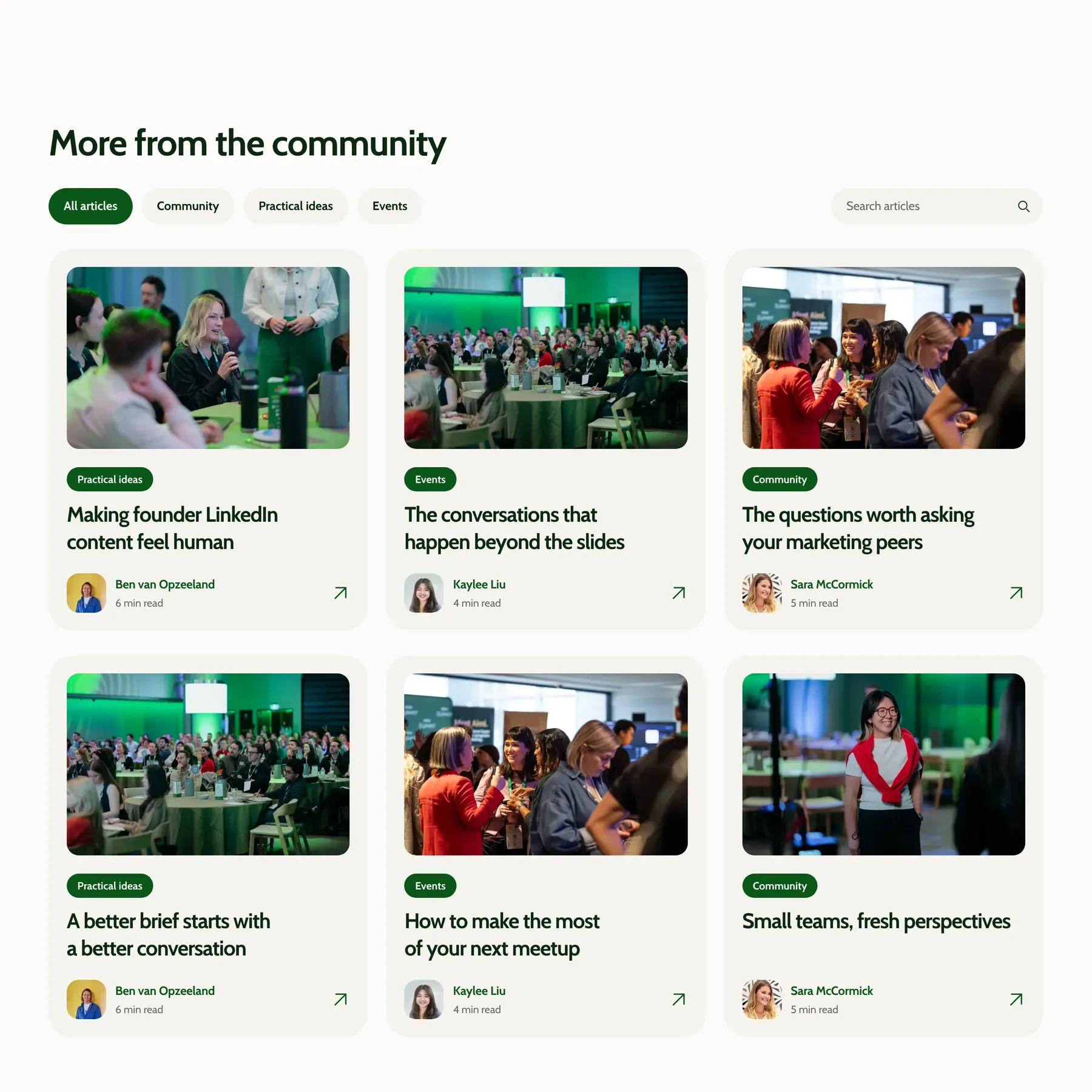
Generate’s blog on its new Astro site. The categories, authors and photos all come from Sanity.
Not everything goes in. The Summit landing page stays as code, where design changes are quicker and safer than in a form.
Beyond the blog
G Plus is a site we’re building now, also Astro with Sanity. Its model covers programs, locations, events, staff, testimonials and FAQs. Two details show why structured content helps:
- Locations link to programs. Each location picks the programs it runs from one list, instead of typing them out again.
- FAQs are tagged by page. Each question says where it belongs, such as the home page or the programs page, so one list of FAQs feeds several pages without copies.
That’s the rule we follow: model what the content is, not where it appears. The setup itself is in how to use Sanity with Astro.
Sanity vs WordPress
| Sanity | WordPress | |
|---|---|---|
| What it is | A headless CMS: content and editing only | A CMS that also runs the website, with themes and plugins |
| Editing | Forms built from your content model | A page editor plus custom fields, often through plugins |
| The website | Any front end, such as Astro | Usually WordPress itself, or headless with another front end |
| Hosting and upkeep | Sanity hosts the content; your host serves the site | You host and update WordPress, its theme and its plugins |
| Best for | Structured content a team updates often | Teams who want one system, or need its plugin library |
Sanity suits a marketing site where content is structured and the site needs to be fast and custom-designed. WordPress suits teams who want editing, design and hosting in one system. If you’re moving, see our WordPress to Astro migration guide.
Sanity vs Contentful
Both are headless CMSs with hosted content and APIs. The practical differences are in editing and price. Sanity Studio is open source and shaped in code around your content, while Contentful’s editing app is a hosted web app. On price, Sanity’s free plan covers 20 seats; Contentful’s free plan is for testing and learning, not commercial use, and its paid plans started at US$300 a month for Lite when we checked on 11 October 2026 (Contentful, Contentful).
For a marketing site of typical size, Sanity is usually the cheaper start. We compare more options in Astro CMS: the best options.
Sanity vs Webflow CMS
Webflow’s CMS is part of the Webflow platform, alongside its visual editor and hosting. Sanity holds content only, and a separate front end, such as an Astro site, turns it into pages. So the choice is really about how you want the whole site built and edited.
| Sanity | Webflow CMS | |
|---|---|---|
| What it is | A headless CMS: content and editing only | Part of a website platform, with a visual editor and hosting |
| Who edits what | Your team edits content in forms; page layouts are set in code by a developer | Your team edits content and builds pages from the site’s components, in the browser |
| Content structure | Any content model, with references between documents | Collections with custom and reference fields: 40 collections and 20,000 items on Premium |
| The website | Any front end, such as Astro, hosted separately | Designed, built and hosted in Webflow |
| Cost | Free for up to 20 seats; Growth is US$15 per seat a month, plus hosting | In Webflow’s Premium site plan, US$25 a month billed yearly, hosting included |
Prices as of 29 October 2026, from sanity.io/pricing and webflow.com/pricing.
Choose Webflow if your marketing team wants to build and edit pages itself, with hosting and upkeep handled in one plan. Choose Sanity if your content is structured and reused across many pages, or the site is built as code. We build both: Generate’s new site runs on Astro with Sanity, while Altus’ marketing team builds pages and publishes from the CMS in Webflow. For the wider choice, see Webflow vs Astro.
When you don’t need Sanity
- The content rarely changes. A site with a handful of pages updated twice a year doesn’t need a second system.
- Developers or an AI assistant make the changes. Content can live as Markdown files in the site itself. Our own site works this way: we trialled Sanity and Keystatic and went back to files.
- Your team wants to design whole pages itself. A visual platform such as Webflow may suit you better; see Sanity vs Webflow CMS above.
Questions we get asked
What is Sanity CMS?
Sanity is a headless CMS. Content is stored in its hosted database, the Content Lake, and edited in Sanity Studio, an open-source editing app built from your content model. Websites and apps fetch the content through an API, so Sanity works with any front end, such as Astro.
Is Sanity free?
It has a free plan: up to 20 seats, two public datasets and 10,000 documents, as of October 2026. The Growth plan is US$15 per seat a month and adds roles such as Editor and Contributor, private datasets, comments and scheduled drafts. Enterprise pricing is custom.
Is Sanity better than WordPress?
For a structured marketing site built with a modern front end, often yes: there are no themes or plugins to keep updated, and editors fill in clear fields. WordPress suits teams who want editing, design and hosting in one system, or who rely on its plugins.
Should I use Webflow or Sanity?
Use Webflow if your marketing team wants to build and edit pages itself in a visual editor, with hosting included. Use Sanity if your content is structured and reused across pages and the site is built as code, such as with Astro. Sanity is only a CMS, so it also needs a front end and a host.
What is Sanity used for?
Content a team updates often and reuses across pages: blog posts, events, speakers, team profiles, locations and FAQs. On Generate’s new site, it holds the blog and the Summit’s speakers. Pages that rarely change, or need design work each time, are often better kept in code.
Is Sanity open source? Can I self-host it?
Sanity Studio, the editing app, is open source, and you can host it yourself or embed it in your site. The content itself always lives in Sanity’s hosted Content Lake, so the CMS as a whole can’t be self-hosted. If you need that, look at Payload, Strapi or Directus.
Can a marketing team use Sanity without a developer?
For editing, yes: once it’s set up, editors fill in forms in Sanity Studio and publish without touching code. But a developer sets up the content model and builds the website that displays it, and new page designs need a developer too. That’s the trade-off against a visual platform such as Webflow.
Is Sanity Studio easy for non-technical editors?
Yes, once it’s set up well. Editors see forms with clearly named fields, such as a speaker’s name, photo and bio, rather than a page builder, so there’s little to learn and little to break. How easy it feels depends on the content model: a developer who names fields plainly and hides what editors don’t need makes the difference.
Does Sanity host my website?
No. Sanity hosts your content and, if you like, Sanity Studio. The website itself is built by a front end such as Astro and served by a host such as Vercel, which can rebuild the site whenever someone publishes in Sanity.
If you’d like a site built with Sanity, see our Webflow and custom development service, or tell us about your project.