
Services
Strategy
We find the clearest path from what your business needs to what your website should do.
What’s included
- Page strategy
- Landing page strategy
- Site architecture
- Content planning
- Wireframes
- Migration planning




Branding
We shape a distinct visual identity that works on screen first and carries through everything you make.
What’s included
- Visual identity
- Brand refresh
- Colour & typography
- Moodboards & direction
- Brand guidelines
- Digital brand systems
Recent work


Design
We turn the plan into a distinct, usable design that feels right for your brand and works across every screen.
What’s included
- Website design
- UI design
- Responsive design
- Design systems
- Visual direction
- Content presentation


Development
We build fast, reliable websites in Webflow or with custom code, with the integrations each project needs.
What’s included
- Webflow development
- Custom website development
- Custom interactions
- Performance engineering
- CRM & email integrations
- Booking & payments


SEO & AI search
We make your site easy for search engines and AI assistants to find, understand and point people to.
What’s included
- Technical SEO
- AI search & AEO
- Structured data
- Answer-ready content
- Core Web Vitals
- AI crawler access
Optimisation
We keep improving what happens after launch, using real behaviour data to turn more visitors into enquiries.
What’s included
- Conversion optimisation
- A/B changes
- Landing pages
- Copy reworks
- Analytics & heatmaps
- Monthly improvements
Recent work
Latest
The newest posts, across every topic.



Design
Planning and designing websites, and the tools we use.

Development
Webflow, Astro, Claude Code, CMS choices and what builds really take.


SEO & AI search
Getting found in Google and quoted by AI assistants.



Studio
How we run projects, from proposals to launch week.



AHPRA advertising guidelines: a website guide
What AHPRA’s advertising guidelines mean for a health service website: testimonials and reviews, claims, titles, offers, images and penalties, page by page.
- Written by
 Matthew Bishop
- Published
- Reading time
- 7 minutes
AHPRA’s advertising guidelines apply to anyone advertising a regulated health service, and your website is advertising. Under section 133 of the National Law, it can’t be false or misleading, offer a gift or discount without its terms, use testimonials, create an unreasonable expectation of benefit, or encourage unnecessary use of health services (Ahpra). On a website, that comes down to five things: reviews, claims, titles, offers and images.
This isn’t legal advice, and Ahpra itself can’t approve advertising. It suggests independent legal advice or your indemnity insurer. What follows is how those rules show up when we design and build health service websites, and where to look on your own.
The five rules, on a website
| Section 133 says advertising must not | Where it shows up on a website |
|---|---|
| Be false, misleading or deceptive | Service pages, team bios, titles, statistics, “free” offers |
| Offer a gift, discount or inducement without its terms | Pricing pages, banners, switching or first-visit offers |
| Use testimonials | Review widgets, patient stories, quotes, social feeds |
| Create an unreasonable expectation of beneficial treatment | Outcome claims, recovery times, before-and-after images |
| Encourage indiscriminate or unnecessary use of services | Urgency, scarcity and “book now before it’s too late” messages |
The guidelines in force are Ahpra and the National Boards’ Guidelines for advertising a regulated health service, which took effect on 14 December 2020 (Ahpra).
Who is responsible for the website
The advertiser is whoever controls or authorises the content, and that stays true when staff, a marketing agency or a web developer writes it. Advertisers can be practitioners, businesses or companies, and they’re expected to check what’s produced for them (Ahpra).
So the practical question for a website project is who signs off. Agree who drafts each page, who checks claims, testimonials and disclaimers, and who approves the page on staging before it goes live. Our healthcare website checklist covers that workflow. If you also advertise medicines or medical devices, the TGA’s separate rules apply too: see our TGA advertising code guide.
Testimonials and reviews
A testimonial, in Ahpra’s terms, is a positive statement about the clinical aspects of a service: symptoms, diagnosis, treatment or outcomes, including a practitioner’s skill. Comments only about customer service, such as friendly staff or easy parking, aren’t testimonials (Ahpra).
On a website, that means:
- Review widgets. A feed of Google or other reviews embedded on your site is your advertising, so it can’t show reviews about clinical outcomes.
- Patient stories and quotes. A story about how a treatment helped someone is a testimonial, however it’s presented.
- Your own social pages. Where you control a page that allows reviews, Ahpra says compliance may be achieved by turning reviews off.
- Third-party sites. You aren’t responsible for reviews on platforms you don’t control, but take care replying to them: engaging with a review can count as using it.
Claims and evidence
Any claim about what a service achieves needs acceptable evidence, and Ahpra ranks systematic reviews of randomised controlled trials highest. Anecdotes, self-assessment studies and studies without human subjects generally don’t count (Ahpra).
Watch the small words too. The guidelines flag “safe”, “effective”, “pain-free” and “risk-free” when they play down risk, and any promise of a guaranteed result or a unique skill.
When a website does need clinical claims, we design each claim and its source as one unit. On the site of Smileyscope, a medical device maker, every statistic carries a footnote to the study behind it, so the evidence can’t get separated from the claim in a later edit.
Titles and qualifications
- “Specialist.” Only practitioners with specialist registration or an endorsement can use the related title, including in business names. “Specialises in” is likely to mislead too; “substantial experience in” is less likely to.
- “Surgeon.” For medical practitioners, it’s reserved for those with specialist registration in surgery, obstetrics and gynaecology, or ophthalmology.
- “Dr.” If someone isn’t a registered medical practitioner, say which profession they’re registered in, as in “Dr Lee (Osteopath)”.
On a website, team pages, bios, page titles and meta descriptions all count, so check them as carefully as the headline copy.
Offers, prices and “free”
An offer needs its terms in plain language. If space is short, it can point to the full terms, as long as they’re easy to find without searching or asking. Ahpra also notes that people read “free” as absolutely free, so a cost recovered elsewhere makes it misleading (Ahpra).
We’ve seen this rule come up directly. When AHPRA asked Doctor Canna, a telehealth clinic we look after, to show the terms of its switching offer next to the offer itself, we had a proposal back within half an hour and the change live the next day.
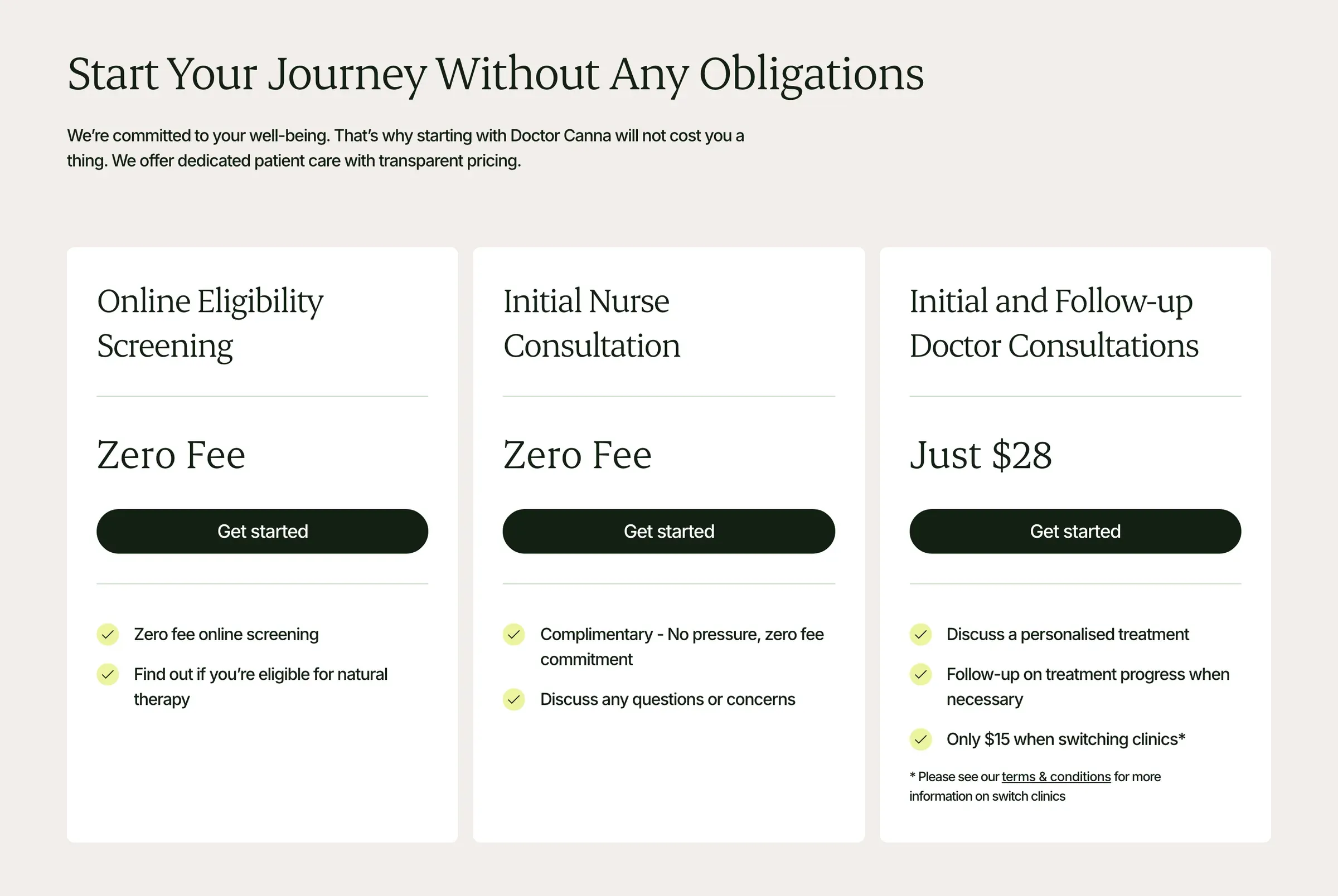
On Doctor Canna’s site, the switching offer’s terms are pointed to right under the offer, not just in the footer.
Before-and-after images
Ahpra says to take care with them. They’re less likely to mislead when both photos match in angle, lighting, framing and background, the treatment is the only visible change, and any editing is explained. Images that are enhanced, or that don’t make clear how the treatment caused the change, can breach the law.
Cosmetic procedures have tighter rules again. Ahpra’s guidelines for higher-risk non-surgical cosmetic procedures, in effect from 2 September 2025, bar advertising aimed at under-18s and make practitioners responsible for what influencers post for them (Ahpra).
What happens if a website breaks the rules
Since a 2022 amendment to the National Law, the maximum penalty for an advertising offence is $60,000 per offence for an individual and $120,000 for a company, and these now apply in every state and territory (Ahpra). Registered practitioners can face disciplinary action as well.
For Doctor Canna, the first contact was a request to change something, not a penalty. A site that’s quick to edit makes that a one-day job rather than a project.
A page-by-page check
Before launch, and whenever a page changes, walk the site with your compliance adviser:
- Home page. No outcome promises, guarantees or urgency in the headline.
- Service pages. Every effectiveness claim has its evidence, and risks aren’t played down.
- Team and about pages. Titles match registration, and “Dr” names the profession where needed.
- Pricing. Every offer, discount or “free” step has its terms beside it or one click away.
- Reviews and stories. No clinical testimonials, including in widgets and embedded social feeds.
- Images. Before-and-after photos are genuine, matched and explained.
- Blog and FAQs. Articles count as advertising too when they promote the service.
- Metadata. Page titles, descriptions and social previews say nothing the page couldn’t.
Ahpra’s advertising hub also has a self-assessment tool for advertisers (Ahpra).
Questions we get asked
Do AHPRA’s advertising guidelines apply to my website?
Yes, if it advertises a regulated health service. A website is advertising, and the guidelines apply to practitioners, businesses and companies alike. The person or business that controls the site is responsible, even when an agency or developer built it.
Can I show Google reviews on my clinic website?
Only if they don’t mention clinical aspects such as symptoms, treatment or outcomes. Reviews shown on your own site count as your advertising, so a live feed you can’t filter is risky. Comments only about customer service, like friendly staff, aren’t testimonials.
Can a clinic website say “free consultation”?
It can, if it really is free and the terms are clear. Ahpra says people read “free” as absolutely free, so a cost recovered elsewhere, such as in a later fee, makes it misleading. Put any conditions next to the offer or one click away.
What are the penalties for breaching AHPRA advertising rules?
Up to $60,000 per offence for an individual and $120,000 for a company, since a 2022 amendment to the National Law, now in force in every state and territory. Registered practitioners can also face disciplinary action.
Can my web agency make my site AHPRA compliant?
An agency can build the site around the rules and make changes fast, but compliance stays with you as the advertiser. We plan pages without clinical testimonials, design claims next to their evidence, and have your compliance adviser sign off each page on staging.
If you’re planning a health service website, see our healthcare websites and healthcare SEO, or tell us about your project.