
Services
Strategy
We find the clearest path from what your business needs to what your website should do.
What’s included
- Page strategy
- Landing page strategy
- Site architecture
- Content planning
- Wireframes
- Migration planning




Branding
We shape a distinct visual identity that works on screen first and carries through everything you make.
What’s included
- Visual identity
- Brand refresh
- Colour & typography
- Moodboards & direction
- Brand guidelines
- Digital brand systems
Recent work


Design
We turn the plan into a distinct, usable design that feels right for your brand and works across every screen.
What’s included
- Website design
- UI design
- Responsive design
- Design systems
- Visual direction
- Content presentation


Development
We build fast, reliable websites in Webflow or with custom code, with the integrations each project needs.
What’s included
- Webflow development
- Custom website development
- Custom interactions
- Performance engineering
- CRM & email integrations
- Booking & payments


SEO & AI search
We make your site easy for search engines and AI assistants to find, understand and point people to.
What’s included
- Technical SEO
- AI search & AEO
- Structured data
- Answer-ready content
- Core Web Vitals
- AI crawler access
Optimisation
We keep improving what happens after launch, using real behaviour data to turn more visitors into enquiries.
What’s included
- Conversion optimisation
- A/B changes
- Landing pages
- Copy reworks
- Analytics & heatmaps
- Monthly improvements
Recent work
Latest
The newest posts, across every topic.



Design
Planning and designing websites, and the tools we use.



Development
Webflow, Astro, Claude Code, CMS choices and what builds really take.
SEO & AI search
Getting found in Google and quoted by AI assistants.



Studio
How we run projects, from proposals to launch week.



Fixed price or retainer for a website project?
Should a website project be fixed price or a monthly retainer? When each works, what each should include, our ranges ex GST, and how to mix the two.
- Written by
 Matthew Bishop
- Published
- Reading time
- 5 minutes
Use a fixed price for work you can define up front, like a new website, a redesign or a migration, and a monthly retainer for the open-ended work that follows, like new landing pages, fixes and improvements. Most website relationships use both: a fixed-price build, then reserved studio time each month once the site is live. The mistake is using one for the other’s job: a retainer for a build with no agreed scope, or a fixed quote for a year of changes nobody can list yet.
Here’s how we use each, what each should include, and how to choose.
The two models
| Fixed price | Retainer | |
|---|---|---|
| Best for | A defined project: a new site, redesign, migration or landing page | Ongoing work after launch: pages, components, fixes, tests |
| What’s agreed | The scope, the price and the timeline | Studio time each month, and the priorities for that month |
| Your risk | Paying for scope you didn’t need, or extras when scope grows | Paying for time you don’t use |
| The studio’s risk | The work taking longer than quoted | Little, since the time is reserved, so a good retainer is flexible |
| How changes are handled | Quoted before they’re made | Ranked into next month’s list |
| Our pricing, ex GST | Landing page $1,500–3,000; marketing site $15,000–25,000; larger redesign $30,000–45,000 | Support plans from $450 a month |
Our ranges are from quotes since mid-2025. What moves a quote within them is in how much a website costs in Australia.
When a fixed price works
A fixed price works when the work can be written down: the page templates, the content to move, the integrations, the languages and the number of review rounds. It gives you a number to take to the budget holder, and it puts the risk of the work running long on the studio.
Most of our projects are a fixed price for an agreed scope, given as a range early on and confirmed in the proposal. A few things make a fixed price fair for both sides:
- A written scope. Templates, not pages, are the unit: ten case studies on one template are far less work than ten different layouts.
- Review rounds stated. Feedback is built into each stage, and the proposal says how many rounds are included.
- Changes quoted first. Anything outside the scope is quoted before it’s done, never added to the bill afterwards.
- A plan for copy. We plan builds for two and a half to three months. When one runs longer, it’s usually waiting on copy or approvals, so agree who writes the words and when.
Investigative or technical work that can’t be scoped up front, like untangling an old integration, is fairer estimated in hours and billed on actual time, with anything beyond the estimate flagged first.
When a retainer works
After launch, the work stops being a list you can write once. A campaign needs a landing page, the team spots a missing component, a form needs fixing, a page could convert better. A retainer, studio time reserved each month, fits that work:
- Priorities change monthly. Each month starts with a short list of changes, agreed together and ranked by impact and effort.
- Nothing waits on a quote. Small changes go straight into the month, rather than through a proposal each time.
- Time is tracked, and anything bigger than the month allows is flagged before it starts.
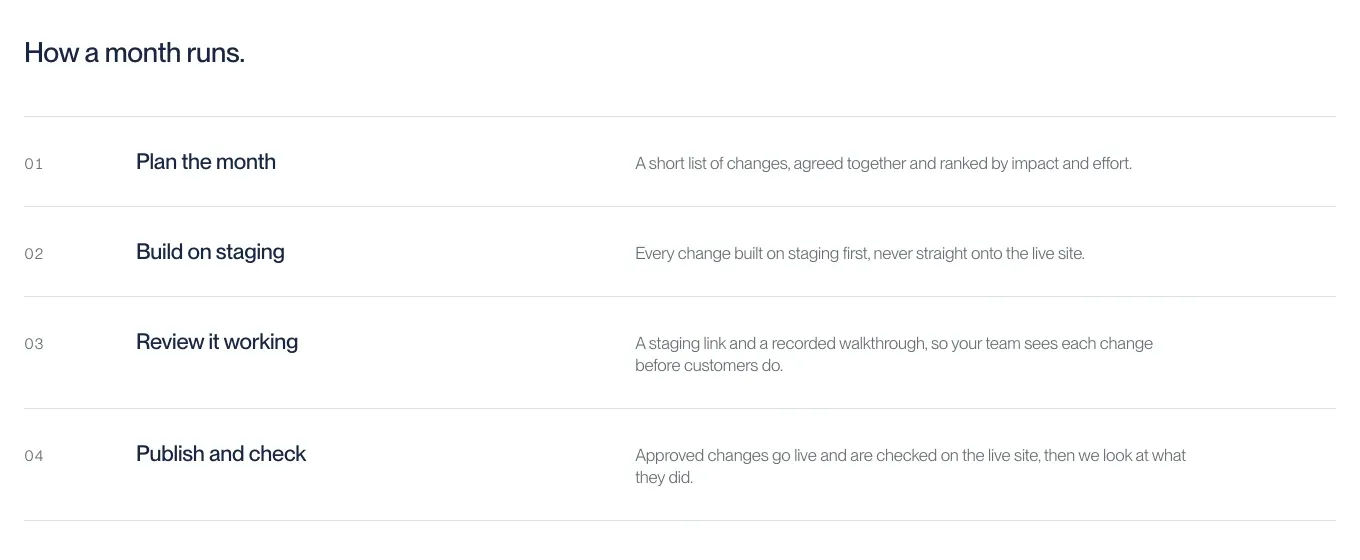
How a month of ongoing support runs on our website maintenance page.
A good retainer is flexible, because the studio carries little risk. Ours can be paused or ended with 30 days’ notice, and the finished site is yours either way. If a retainer locks you in for a year with no way to scale it down, ask why.
How to mix the two
This is how we usually work:
- Build at a fixed price. The site is scoped, quoted and built, with training and walkthroughs at handover.
- Aftercare included. Every build includes 30 days of aftercare to fix anything on our side.
- Then choose how much ongoing help you need. Small fixed-fee jobs as needs come up, a block of support hours to use when you need them, or a monthly support plan.
A team that runs a campaign every month gets the most from a monthly plan. A team that changes its site twice a year is better off with fixed-fee jobs or a block of hours. Webflow maintenance: what support includes covers what that time usually goes on.
What to ask before you sign
- For a fixed price: What exactly is in scope? How many review rounds? Who supplies copy and images? How are changes priced? What happens after launch?
- For a retainer: How is time tracked and reported? What happens to unused time? Can we pause, scale down or stop, and with how much notice? Who owns the work?
Questions we get asked
Is a retainer cheaper than paying per project?
Not by itself. A retainer suits steady, ongoing work, where reserving time each month saves quoting every change. If you only need changes now and then, fixed-fee jobs or a block of hours usually cost less than a monthly plan you don’t fully use.
Can a website build be done on a retainer?
It can, but we don’t recommend it for a new site. A build has a clear scope, so a fixed price gives you a firm number and a timeline. Retainers work best after launch, when the work is a changing list rather than a defined project.
What happens when a fixed-price project needs more work?
It depends on why. Changes after sign-off, or new pages beyond the scope, are quoted before we make them. If the scope needs trimming to fit a budget, extras can move to a second phase, or labour-heavy tasks can go to your team with guidance.
Do we need ongoing support after launch?
Not always. A Webflow site keeps running without us, with hosting, security and backups handled by Webflow. Support is for improving the site: new pages, components, fixes and tests. If your team builds pages itself, you may only need help now and then.
If you’d like a quote for either, see our website maintenance service, or tell us about your site.