
Services
Strategy
We find the clearest path from what your business needs to what your website should do.
What’s included
- Page strategy
- Landing page strategy
- Site architecture
- Content planning
- Wireframes
- Migration planning




Branding
We shape a distinct visual identity that works on screen first and carries through everything you make.
What’s included
- Visual identity
- Brand refresh
- Colour & typography
- Moodboards & direction
- Brand guidelines
- Digital brand systems
Recent work


Design
We turn the plan into a distinct, usable design that feels right for your brand and works across every screen.
What’s included
- Website design
- UI design
- Responsive design
- Design systems
- Visual direction
- Content presentation


Development
We build fast, reliable websites in Webflow or with custom code, with the integrations each project needs.
What’s included
- Webflow development
- Custom website development
- Custom interactions
- Performance engineering
- CRM & email integrations
- Booking & payments


SEO & AI search
We make your site easy for search engines and AI assistants to find, understand and point people to.
What’s included
- Technical SEO
- AI search & AEO
- Structured data
- Answer-ready content
- Core Web Vitals
- AI crawler access
Optimisation
We keep improving what happens after launch, using real behaviour data to turn more visitors into enquiries.
What’s included
- Conversion optimisation
- A/B changes
- Landing pages
- Copy reworks
- Analytics & heatmaps
- Monthly improvements
Recent work
Latest
The newest posts, across every topic.



Design
Planning and designing websites, and the tools we use.

Development
Webflow, Astro, Claude Code, CMS choices and what builds really take.


SEO & AI search
Getting found in Google and quoted by AI assistants.



Studio
How we run projects, from proposals to launch week.



TGA advertising code: a website guide
What the TGA’s Therapeutic Goods Advertising Code means for a medical device or health product website: required statements, claims, reviews and gated pages.
- Written by
 Matthew Bishop
- Published
- Reading time
- 8 minutes
The Therapeutic Goods Advertising Code sets the rules for advertising medicines and medical devices to the public in Australia, and a product website is advertising. Each product page needs the product’s name, an accepted purpose from its ARTG entry and a mandatory statement, shown clearly on the same page. Any claim that leans on research needs a citation. Testimonials have strict limits, and some goods, including anything not yet in the ARTG, can’t be advertised to the public at all (TGA).
This isn’t legal advice. The TGA takes advertising enquiries, and your regulatory adviser should sign off claims and pages. What follows is how the Code shows up when we design and build health product websites.
TGA or AHPRA: which rules apply?
| You’re advertising | Rules that apply |
|---|---|
| A medicine, medical device or other therapeutic good | The TGA’s rules: the Therapeutic Goods Act and the Advertising Code |
| A health service, such as a clinic or telehealth service | Ahpra’s rules: section 133 of the National Law and the advertising guidelines |
| A health service that promotes therapeutic goods | Both |
The current Code is the Therapeutic Goods (Therapeutic Goods Advertising Code) Instrument 2021 (TGA). Consumer law, which the ACCC enforces, applies on top (TGA). For the clinic side, see our AHPRA advertising guidelines guide.
What every product page has to show
The Code requires an advertisement, other than a label, to include (TGA):
- The product’s name, or a device’s trade name.
- For a device, an accurate description of it.
- At least one accepted indication or intended purpose, as recorded in its ARTG entry.
- The mandatory statement for that type of good. For medical devices, that’s “Always follow the directions for use” or “Always read the label and follow the directions for use”.
These have to be “prominently displayed”. On a website, that means on the same page or screen as the product, easy to read in its font, size, contrast and placement, and not hidden by design tricks that divert attention from it (TGA). On social media the bar is higher: the statement must be visible at all times, not collapsed behind “see more” and not below a scroll.
So design the statement into the product page template, not as small print in the footer. That way every new product page gets it automatically.
If people can buy from the page
When a page lets people buy a product they can’t inspect first, it may also need the product’s health warnings: the warnings, contraindications or precautions required on its label or instructions for use. They, or a direct link to them, must be prominent. Show them in text as well, not only in a photo of the label, so they still work when an image doesn’t load or someone uses a screen reader (TGA).
Claims, research and citations
Any claim that refers to research, or implies it with words like “clinically proven” or “lab studies show”, needs a citation. The citation must name the researcher, name the financial sponsor where you know it, and let readers find the study. Footnotes and embedded links can be enough (TGA).
The claims also have to match the wider body of evidence, avoid jargon, and not exaggerate a study’s conclusions.
On Smileyscope’s site, a medical device maker, every statistic carries a footnoted citation to its study, kept in even where space is tight. We designed each statistic with its citation in place, rather than adding sources afterwards.
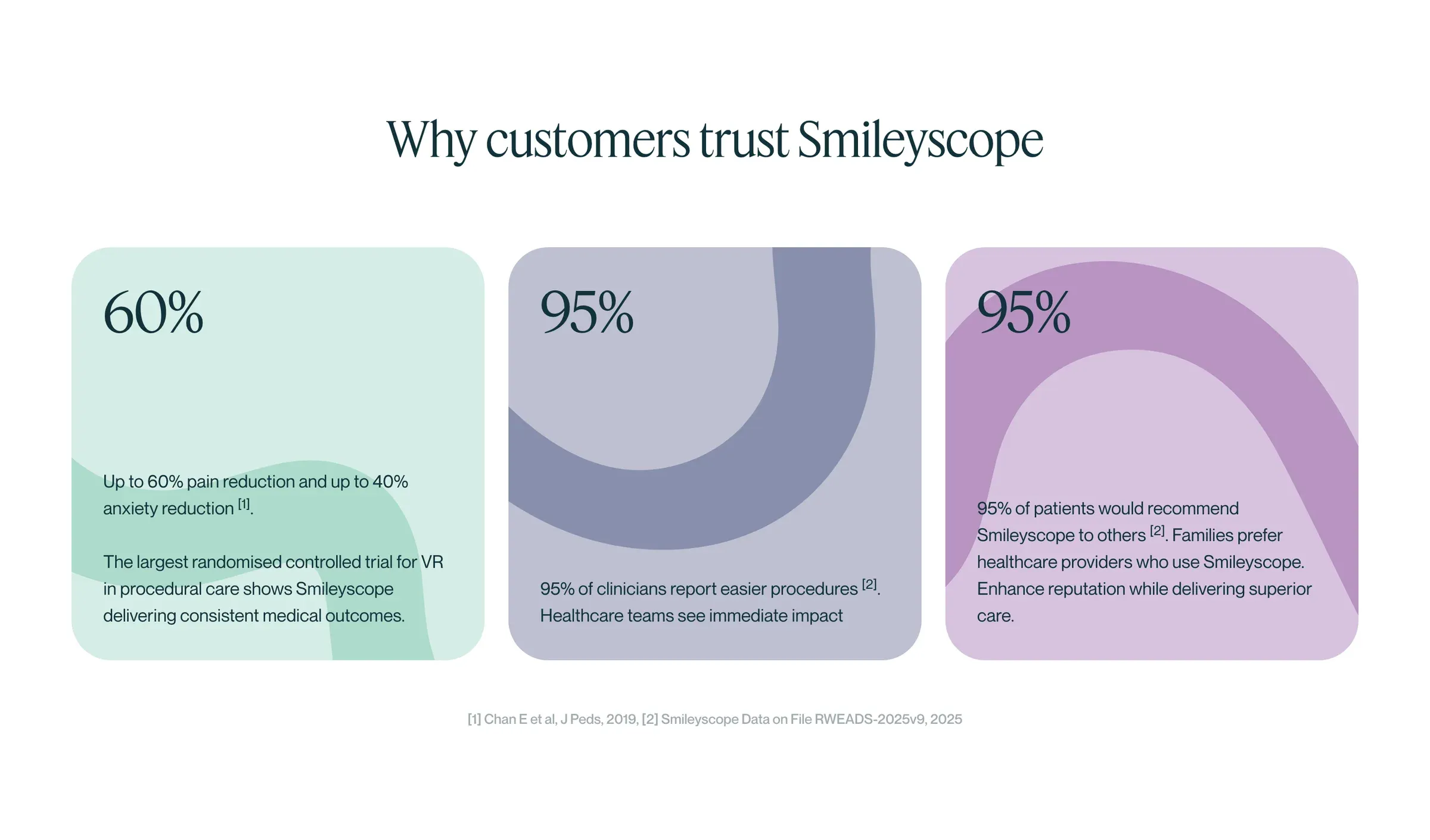
On Smileyscope’s site, each statistic is designed with its footnote in place.
Testimonials, reviews and endorsements
The TGA counts product reviews and user comments as testimonials, and anything on or linked from your page as your advertising, even if you didn’t write it (TGA). The key rules:
- Who can’t give one. Current or former health practitioners, health professionals and medical researchers; hospitals and healthcare facilities and their staff; and government bodies, outside health campaigns.
- No paid testimonials. Anyone paid or rewarded for one, including influencers and brand ambassadors, counts as part of your marketing, so their testimonial can’t be used.
- Check before you publish. Confirm who wrote a testimonial and that it fits the Code, including staying within the product’s ARTG purpose and its typical results.
- Endorsements are different. A paid endorsement can be allowed if the payment is disclosed, but not from the people and organisations listed above.
On a website, that rules out an unfiltered review widget, and it means checking where your links go: linked material, even overseas, counts as part of the advertisement.
“TGA approved” and the ARTG number
You can’t say a product is “TGA approved”, “TGA registered” or “FDA approved”, or use the TGA logo or the Coat of Arms. You can, and are encouraged to, show the ARTG number in the TGA’s wording, such as “Product X is entered in the ARTG, (ARTG number)” for a device (TGA).
Pages for health professionals
Advertising aimed only at health professionals is exempt from most of the consumer rules. But online, the TGA says the content has to be secured so only confirmed health professionals can reach it (TGA). Its examples include:
- a username and password, issued once you’ve checked the person’s Ahpra registration
- access only from a hospital’s own network or approved systems
A “Yes, I’m a health professional” button isn’t the kind of separation those examples describe. Factual, non-promotional information for clinicians doesn’t need gating, and promoting a use outside the ARTG entry is banned even to health professionals.
So decide early which pages are public, which are factual, and which need a login. A gated area means accounts, verification and a CMS set up to keep the two audiences apart, and it changes the scope of the build.
Products not yet in the ARTG
Goods that aren’t in the ARTG, or exempt from it, can’t be advertised to the public, and neither can prescription-only medicines or most pharmacist-only medicines (TGA).
That matters for companies with products in development. Operational information about the company isn’t advertising, but the TGA treats content as promotional when it calls readers to act, creates a favourable impression of a product, stresses benefits, or uses words like “breakthrough” and “life changing” (TGA). A site for a pre-approval product needs careful wording on every page, and a plan for what changes once it’s in the ARTG.
Blog posts and articles
Articles count too. In one TGA example, health articles on a site that sells medical devices are likely part of the advertising for those devices, even when they don’t name a product (TGA). So your journal goes through the same review as your product pages.
What happens if a site gets it wrong
The Therapeutic Goods Act has criminal offences and civil penalties for advertising that breaks the rules, and the TGA publishes the directions and prevention notices it issues to advertisers (TGA, TGA). The TGA also has a checklist for checking your own advertising.
A page-by-page check
- Product pages. Name, description, ARTG purpose and mandatory statement, on the page and easy to read.
- Buy buttons. Health warnings in text, or a direct link to them, wherever people can buy.
- Claims. Every research claim cited, with researcher and sponsor.
- Reviews and quotes. No testimonials from practitioners, hospitals, researchers or paid partners.
- Approval language. No “TGA approved”; ARTG numbers in the TGA’s wording.
- Clinician content. Promotional material behind a verified login, not a click-through.
- Pipeline products. Nothing promotional about goods not yet in the ARTG.
- Journal and links. Articles and linked pages reviewed like the rest of the site.
Questions we get asked
Does the TGA Advertising Code apply to my website?
Yes, if it promotes a therapeutic good to the public. A website is advertising, and so are reviews and linked content on it. Content directed only at health professionals is exempt from most rules, but online it has to be secured so only confirmed health professionals can see it.
Can I put testimonials on a medical device website?
Sometimes. Genuine testimonials from ordinary users can be allowed if you’ve confirmed who wrote them and they fit the Code. Testimonials from health professionals, hospitals, researchers or anyone paid for them, including influencers, can’t be used.
Can I say my product is TGA approved?
No. Phrases like “TGA approved”, “TGA registered” and “FDA approved”, and the TGA logo, can’t be used. You can show the ARTG number in the TGA’s wording, such as “Product X is entered in the ARTG”, followed by the number.
Can a website have a section only for health professionals?
Yes, if it’s properly secured. The TGA’s examples include a username and password issued after checking Ahpra registration, or access only from hospital networks. Factual, non-promotional information for clinicians can stay public.
Can we have a website before our device is in the ARTG?
Yes, but it can’t advertise the device to the public. Company information is fine; calls to action, benefit claims and words like “breakthrough” about the product are likely to be promotional. Plan the pages that change once the device is in the ARTG.
If you’re planning a medical device or health product website, see our healthcare websites and healthcare SEO, or tell us about your project.
Sources
- TGA, What can and cannot be advertised to the general public
- TGA, Mandatory statements and other information required in advertising
- TGA, Applying the Advertising Code rules: prominently displayed or communicated information
- TGA, Using scientific or clinical representations in advertising
- TGA, Testimonials and endorsements in advertising
- TGA, The claim ‘TGA approved’ must not be used in advertising
- TGA, Advertising to health professionals so that consumer rules do not apply
- TGA, Determining if your content is advertising
- TGA, Advertising legal framework
- Smileyscope case study