
Writing pages that AI assistants can quote
Pages AI assistants quote are mostly well written and technically sound. What Google, OpenAI and Anthropic say, and what to change on your own pages.
- Written by
 Matthew Bishop
- Published
- Reading time
- 7 minutes
A page that AI assistants can quote is mostly a well-written page on a technically sound site, with no special trick. Put the answer first, give each question its own section, state specific facts with their sources, and make sure the right crawlers can reach the page. Google says its AI Overviews and AI Mode rest on the same foundations as the rest of Search.
What Google actually says
Google’s guidance is plain: “There are no additional requirements to appear in AI Overviews or AI Mode, nor other special optimizations necessary” (Google Search Central). To be shown as a supporting link, a page has to be indexed and eligible to appear in Search with a snippet, the same as any other result.
Its newer guide, added in May 2026, says these features are rooted in Google’s core ranking systems, that optimising for them “is optimizing for the search experience, and thus still SEO”, and that you can ignore tactics like chunking content or rewriting it for machines (Google Search Central).
ChatGPT and Claude run their own search, and can only quote what they can fetch and read. So everything below is written for people first.
Put the answer first
Open each page and section with the answer, in a sentence that still makes sense lifted out on its own. Then explain.
| Instead of | Write |
|---|---|
| “We’re passionate about helping teams grow online.” | “We design and build marketing websites for B2B teams.” |
| “Delivery is fast and reliable.” | “Orders placed by 2pm ship the same day.” |
| “Get in touch to learn more about pricing.” | “Plans start at $X a month, billed yearly, as of October 2026.” |
The last two rows are made-up examples. The right-hand column can be quoted; the left can’t.
One question per section
Give each question people ask its own heading, worded the way they’d ask it, with the answer straight under it. Google says you don’t need to chunk content for its systems; the reason to do this is that readers find their question faster. A section that answers one thing is also easy to point to.
Specific facts, with sources and dates
Vague claims give an assistant nothing to repeat. Use numbers, names and dates, link primary sources, and date anything that changes, such as prices.
Google’s guide puts the weight on “non-commodity” content: first-hand experience rather than a summary of what’s already out there. The GEO paper (Aggarwal et al., KDD 2024) found that adding citations, quotations and statistics raised a page’s visibility in generative answers by roughly 30 to 40% on its own benchmark (arXiv). That’s one study on one benchmark, so read it as a direction, not a guarantee.
FAQs on the pages that already matter
Put questions on the pages they belong to, where the answer has context, rather than one long FAQ page. Keep answers short, with the answer in the first sentence.
Fresh Clinics stores more than 90 FAQs once in its CMS and shows them on the pages they belong to. They were written with Fresh’s SEO agency to answer the questions nurses actually search for (Fresh Clinics case study). Each of our own service pages has its FAQs, such as SEO & AI search.
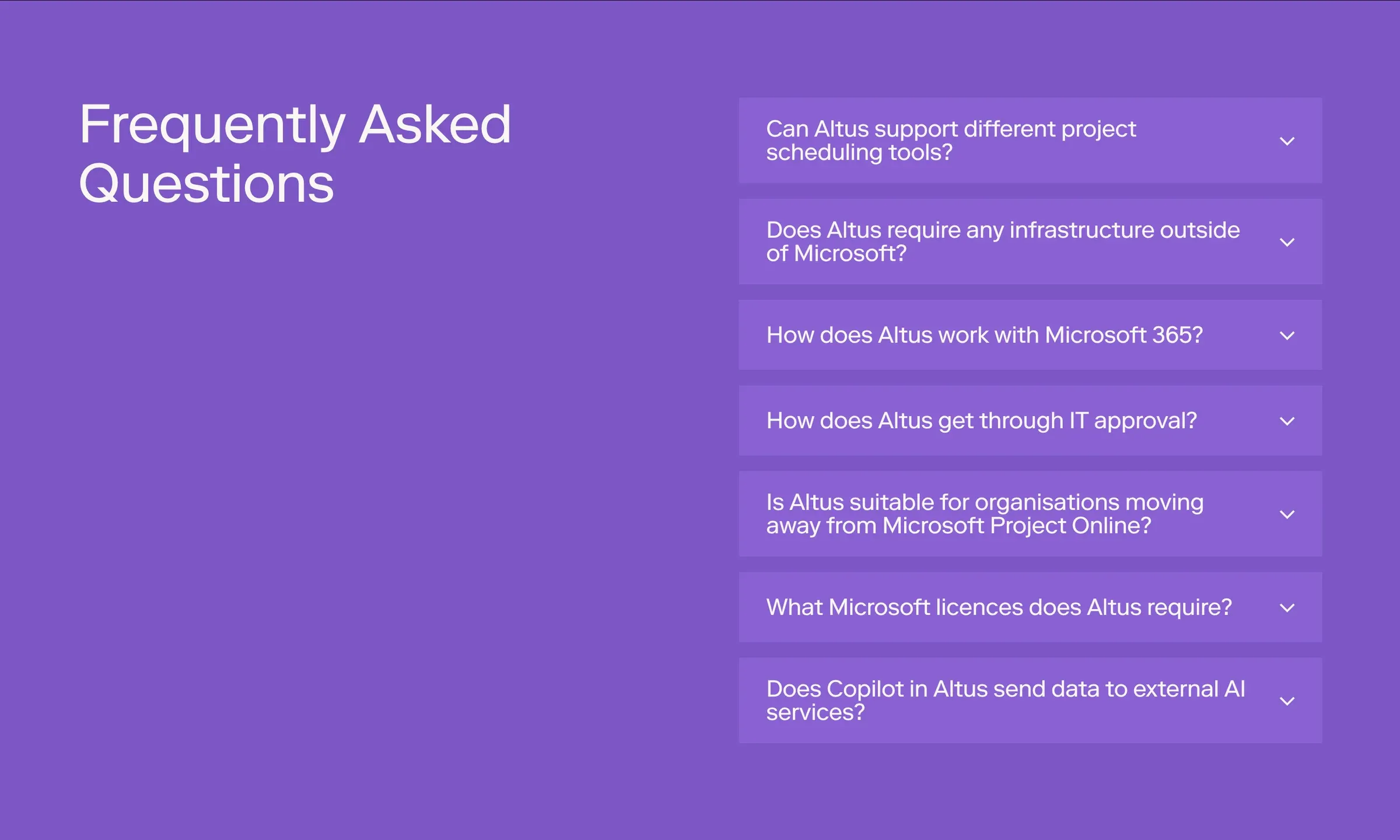
An FAQ section on the Altus site.
Structured data that matches the page
Structured data helps machines read a page’s facts, but it isn’t a shortcut. Google says there’s “no special schema.org structured data that you need to add” for its AI features, and that your structured data should match the visible text on the page (Google Search Central).
Don’t oversell FAQ markup either. Google stopped showing FAQ rich results on 7 May 2026 and has since removed their documentation (Google Search Central). FAQPage markup can still describe a page’s questions, but it no longer earns a special result.
Mark up what’s already on the page. Altus has structured data for the organisation, the software, articles and breadcrumbs, with FAQ markup on its three product pages (Altus case study). Generate’s site describes the organisation, the Summit as an event and its FAQs (Generate case study). On our own site, each service page’s FAQ markup is built from the same list as the questions you see, so the two can’t drift apart.
Let the right crawlers in
None of this matters if the page can’t be fetched, so check that robots.txt, and any CDN or firewall, let crawlers through. Then treat AI search and AI training as separate choices. Each company runs separate bots: OpenAI’s OAI-SearchBot, Anthropic’s Claude-SearchBot and Googlebot fetch pages for search answers, while GPTBot, ClaudeBot and Google-Extended relate to training. You can block training and stay visible in AI search (OpenAI, Anthropic, Google). Our own robots.txt allows the training crawlers too, but that’s a choice, not a requirement.
llms.txt is optional
An llms.txt file is a plain summary of a site for AI tools. Google says Search ignores it: it will “neither harm nor help” your visibility, and it’s fine to keep one for other services that use it (Google Search Central).
Generate’s site has one that tells AI assistants what Generate is, and so does ours. If you keep one, keep it accurate, but it never stands in for the pages themselves.
Being cited isn’t being recommended
A citation is your page linked as the source for a fact. A recommendation is your name on a shortlist when someone asks for the best options. Good pages earn the first. The second depends far more on what others say about you: independent reviews, directories, press and genuine discussion. Google’s guide notes its AI features can show what’s said about products and services in blogs, videos and forums, and that chasing inauthentic mentions doesn’t help much. The work is earning real reviews and coverage.
Measuring it
Answers change from one run to the next, so measure trends, not single results:
- Fix a set of prompts: the questions your customers would ask, run monthly in the assistants they use.
- Record three things separately: whether you were cited, mentioned or recommended. They move for different reasons.
- Check Search Console. AI Overviews and AI Mode count towards the Performance report, and Google’s guide points to a Generative AI performance report as well.
- Watch referrals. Our PostHog setup records a
visit_from_aievent when a visit comes from ChatGPT, Perplexity, Claude, Gemini or Copilot. It undercounts, because some apps send no referrer and people who come back later look like any other visit, so treat it as a floor.
Questions we get asked
Do we need to write differently for AI assistants?
No. Write clearly for the people you want to reach: answer first, one question per section, specific facts with sources. Google says you don’t need to write in a special way for its AI features, and the same habits help readers and every other assistant.
Should we block GPTBot or ClaudeBot?
That’s a choice about training, not visibility. GPTBot and ClaudeBot collect content for model training; OAI-SearchBot and Claude-SearchBot serve search. You can block the training crawlers and still allow the search ones, so your pages can appear in ChatGPT and Claude answers.
Do we need an llms.txt file?
Not for Google, which says Search ignores llms.txt files and they neither help nor harm rankings. Some other tools read them, so a short, accurate one is cheap to keep. It doesn’t replace clear pages.
Can you guarantee we’ll be cited by ChatGPT or AI Overviews?
No one can. We can remove the technical barriers, structure the content and help it say clearly what you do, which is what these systems rely on. Being recommended also depends on reviews and coverage outside your site.
If you’d like your site checked for what search engines and AI crawlers can see, that’s where our SEO & AI search work starts. Tell us about your site.
Sources
- Google Search Central, AI features and your website, read 9 October 2026
- Google Search Central, Optimizing your website for generative AI features on Google Search, read 9 October 2026
- Google Search Central, Documentation updates: FAQ rich result deprecation (8 May 2026) and removal, and llms.txt guidance (15 June 2026)
- Google, Google’s common crawlers, read 9 October 2026
- OpenAI, Overview of OpenAI crawlers, read 9 October 2026
- Anthropic, Does Anthropic crawl data from the web, and how can site owners block the crawler?, read 9 October 2026
- Aggarwal et al., GEO: Generative Engine Optimization, KDD 2024